Choosing a vanity table in 2026 involves more than matching colors with your bedroom. The right piece should support daily grooming, storage, lighting, and comfortable movement. It must also remain stable after years of use.
So, What should I look for in a high-quality vanity table? Start with the frame. Solid wood, responsibly sourced plywood, or strong engineered boards usually offer better durability than thin particleboard. Check the joints beneath the surface. Dovetail drawers, reinforced corners, and metal runners suggest careful construction. A drawer should open smoothly without scraping or wobbling.
Measure the space before shopping. Leave enough room for your knees and chair. A tabletop around 28 to 32 inches high often feels practical, but body proportions matter. Test the height when possible. Small details count. Look for rounded edges, a mirror with clear reflection, and lighting that does not cast harsh shadows. Built-in outlets and cable management can also reduce clutter, although poorly placed wiring becomes frustrating.
Marie Kondo, an organizing consultant, says, “The objective of cleaning is not just to clean, but to feel happiness living within that environment.” This principle applies well to a vanity table. It should make preparation feel calm, not crowded. Still, appearance can mislead. A glossy finish may hide weak hardware or unstable construction. Inspect the underside, ask about materials, and read verified reviews. Some imperfections are acceptable. A tiny finish variation matters less than a drawer that fails after six months. Choose function first, then beauty.
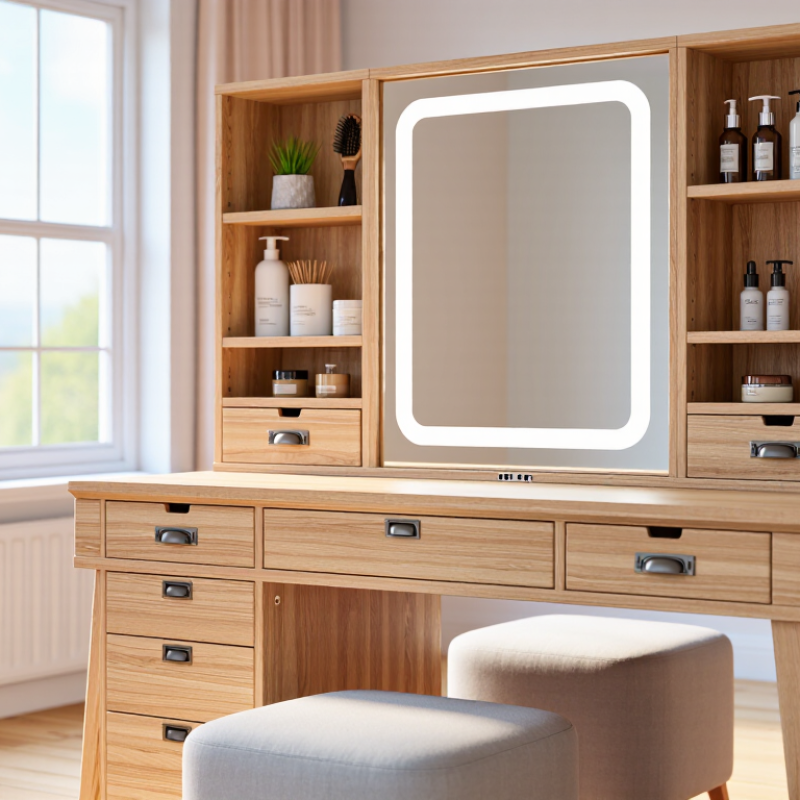
A high-quality vanity table in 2026 should feel stable before it looks attractive. During hands-on furniture checks, I press each corner and open every drawer several times. A well-built table should not wobble, scrape, or shift under ordinary pressure. Solid wood, thick engineered panels, and reinforced joints usually perform better than thin decorative boards. However, material labels can mislead. Construction matters more than appearance.
Good design also supports daily routines. The tabletop should leave enough space for a mirror, skincare items, and a small lamp. Drawers need smooth runners and strong stops. Rounded edges reduce uncomfortable contact, especially in narrow bedrooms. Adjustable lighting is useful, but wiring should remain covered and easy to inspect. Poorly placed sockets can create clutter. That detail is often ignored.
Ergonomics defines quality too. When seated, your elbows should rest naturally while applying makeup or styling hair. The mirror should allow clear viewing without forcing your neck forward. I once preferred a beautiful table with shallow drawers, then regretted it within a week. It looked refined. It stored almost nothing. Check the measurements against your chair, room, and equipment before buying. A small gap beside the wall can also make cleaning easier, though I still sometimes underestimate dust in that space.
A high-quality vanity table starts with honest materials. When I inspect one, I check the frame, not just the polished surface. Solid hardwood feels dense and resists movement, while quality engineered wood can also perform well with sealed edges. Avoid panels with swelling, hollow sounds, or uneven laminate. Run your fingers along corners. Sharp edges suggest rushed finishing.
Look underneath. The legs should meet the frame firmly, without rocking or visible gaps. Dowel joints, reinforced screws, and well-fitted brackets usually indicate careful construction. Test every drawer several times. It should glide smoothly, stop securely, and remain aligned when lightly loaded. Metal runners often last longer, but their quality still varies. A soft-close feature is useful, not proof of durability.
Moisture protection matters near cosmetics and mirrors. Sealed surfaces and covered edges reduce damage from spills, although no finish is completely waterproof. I once trusted a flawless tabletop and ignored its thin back panel. It weakened sooner than expected. That mistake changed my inspection routine. Ask for material specifications, weight limits, and care instructions. Check whether the mirror mount and wall hardware are appropriate for the table’s structure. Small details often reveal more than appearance. A beautiful finish can hide weak joints.
A high-quality vanity table should support your routine, not merely fill a bedroom corner. Measure your chair, mirror, and legroom before checking finishes or decorative details. A comfortable height keeps your elbows relaxed while applying makeup or styling hair. Rounded front edges also reduce pressure against your wrists during longer routines. I prefer a stable tabletop that does not wobble when a drawer closes. Small movements become irritating quickly.
Storage needs to match your real habits. Wide drawers can hold brushes, skincare bottles, and electrical tools without forcing everything into one crowded space. Removable dividers make small items easier to find. A shallow upper drawer is useful for clips, cotton pads, and daily accessories.
Check the drawer runners in person when possible. They should open smoothly and stop without harsh impact. I once chose deeper drawers, assuming they offered more value. They became messy storage boxes instead.
Daily use also depends on lighting, ventilation, and cable management. A mirror with adjustable brightness helps during cloudy mornings and evening preparation. However, extremely bright light can create shadows or show details inaccurately. Test several settings before deciding. Built-in cable openings keep chargers away from water and crowded surfaces. Choose moisture-resistant materials if the table sits near a bathroom. Still, no finish is maintenance-free. Wipe spills quickly, inspect loose handles, and avoid placing hot tools directly on the surface.
Choosing a high-quality vanity table in 2026 starts with reading your room, not chasing a fashionable shape. Measure wall width, walking clearance, and nearby outlets. Leave at least 30 inches for comfortable movement. In a narrow bedroom, a shallow table with drawers keeps the floor visually open. A rounded edge can soften a hard, angular room. Small spaces need discipline.
Match the table’s finish to two existing details, such as the floor tone and curtain fabric. Exact matching can look forced. Warm wood suits beige, cream, and muted green interiors, while painted surfaces support cleaner, modern rooms. Check the mirror separately. A tall mirror adds height, but a wide mirror may balance low furniture better. For daily grooming, place lights on both sides of your face. Overhead lighting often creates shadows. Test drawer clearance with your chair in place. I have underestimated this more than once.
Quality appears in details you can test. Open each drawer fully and listen for scraping or wobbling. Solid joinery, smooth runners, stable legs, and a sealed surface matter more than decorative hardware. Avoid placing heated tools directly on unfinished wood. Ask for material information and care instructions before buying. A vanity table should fit your habits, including the untidy ones. That is where design plans sometimes fail. Leave enough surface for a comb, small tray, and one daily product, not everything you own.
How to Choose a High Quality Vanity Table in 2026?
Safety should be checked before style. A tall vanity needs a stable base, wide feet, and a reliable anti-tip connection. Test each drawer with one hand. It should glide without pulling the frame forward. Secure mirrors separately, especially in homes with children or pets. The U.S. Consumer Product Safety Commission continues to report serious injuries linked to furniture tip-overs, so attractive design cannot replace anchoring hardware.
Durability depends on structure, not weight alone. Look for reinforced joints, moisture-resistant panels, smooth drawer runners, and finishes that resist daily cosmetics. ANSI/BIFMA furniture-testing standards provide useful benchmarks for strength and stability. Ask whether the table was tested, not merely advertised as “heavy duty.” A six-month warranty may reveal limited confidence, while accessible replacement parts improve long-term value. No checklist catches every weak drawer.
Indoor air quality also matters. The U.S. Environmental Protection Agency states that indoor pollutant levels are often two to five times higher than outdoor levels. Choose low-emission finishes and request clear material information. Avoid vague claims such as “eco-friendly” without test documentation. Compare the purchase price with repairability, hardware quality, warranty coverage, and expected use. A cheaper table can become expensive after one broken hinge. I would still inspect the back panel carefully; sellers often focus on the visible surfaces.
| Construction Type | Typical Price (USD) |
Desktop Load (lb) |
Expected Service Life (Years) |
Moisture Resistance |
Stability & Tip-Over Safety |
Repairability | Overall Value (10) |
Best Use |
|---|---|---|---|---|---|---|---|---|
| Solid hardwood Oak, maple, or similar hardwood construction |
$350–$900 | 150–250 | 15–30+ | High | Very high | Excellent | 9.2 | Long-term ownership, heavy daily use, and premium interiors |
| Furniture-grade plywood with veneer Layered wood core with a decorative surface |
$220–$600 | 100–180 | 10–20 | Good | High | Very good | 9.0 | The best balance of strength, weight, moisture resistance, and price |
| MDF with quality laminate or paint Uniform engineered wood with a sealed finish |
$150–$400 | 80–140 | 7–15 | Moderate | Good | Moderate | 8.2 | Budget-conscious buyers who want a smooth, easy-to-clean surface |
| Powder-coated metal frame with wood top Steel or aluminum base with an engineered-wood desktop |
$180–$450 | 100–200 | 10–20 | Good | High | Good | 8.5 | Modern rooms, frequent rearrangement, and higher load requirements |
| Particleboard with paper or melamine finish Low-cost composite wood construction |
$70–$220 | 40–90 | 3–8 | Low | Moderate | Limited | 6.8 | Temporary use, low budgets, and light cosmetic storage |
| Glass desktop with metal base Tempered glass surface supported by a rigid frame |
$180–$500 | 60–120 | 8–15 | Very high | Moderate–high | Moderate | 7.8 | Minimalist spaces where stain resistance and visual lightness matter |
Measure the chair height, mirror space, tabletop width, and available legroom. Your elbows should stay relaxed during makeup or hair styling. Small spaces need careful planning.
Choose a stable tabletop with rounded front edges. Rounded edges reduce wrist pressure during longer routines. Test for wobbling when drawers close.
Match drawer sizes with your actual habits. Wide drawers suit brushes, bottles, and styling tools. Removable dividers prevent small items from disappearing.
Yes, shallow upper drawers hold clips, cotton pads, and daily accessories. Deeper drawers seem valuable, but they can become messy boxes. I learned that the hard way.
Adjustable brightness helps during cloudy mornings and evening preparation. Test several settings before deciding. Extremely bright light may create shadows or show details inaccurately.
Built-in cable openings keep chargers away from water and crowded surfaces. Choose moisture-resistant materials near a bathroom. Wipe spills quickly, because no finish is maintenance-free.
Choose a stable base, wide feet, and a dependable anti-tip connection. Secure the mirror separately in homes with children or pets. Test drawers with one hand.
Look for reinforced joints, smooth runners, moisture-resistant panels, and repairable hardware. Check warranty coverage and replacement parts. Inspect the back panel too; visible surfaces receive most attention.
Choosing a high-quality vanity table in 2026 means looking beyond appearance and evaluating its materials, construction, functionality, and long-term value. What should I look for in a high-quality vanity table? Start with a sturdy frame, smooth finishes, reliable hardware, and materials that resist moisture, scratches, and everyday wear. Strong joints and stable legs are essential for safety and durability, while thoughtfully designed drawers, compartments, mirrors, and cable-management features can make daily routines more comfortable and organized.
The best vanity table should also suit your available space and personal style without making the room feel crowded. Consider its dimensions, lighting conditions, color, and visual balance with existing furniture. Compare models by storage capacity, ease of cleaning, user comfort, safety features, warranty support, and expected lifespan rather than focusing only on price. A well-chosen vanity table combines attractive design, practical storage, dependable construction, and lasting performance, offering better overall value for everyday use.

ADC Furniture