Why is my memory foam mattress sagging in the middle? The answer often begins beneath the foam. A weak foundation, widely spaced slats, or a bent center support can create a shallow valley under your hips. The foam may be blamed unfairly. Sometimes, the base is the real problem.
Mattress educator Joe Auer, founder of Mattress Clarity, has said, “A mattress should be evaluated with its foundation, not by itself.” This practical point matters. Memory foam slowly softens where pressure repeats every night. Body weight, room temperature, moisture, and mattress age can accelerate that change. A warm bedroom may make the center feel noticeably softer by morning. A heavy sleeper may also create deeper compression than a lighter sleeper. That is not a personal failure. It is material fatigue.
Look closely. Remove the sheets and measure the dip with a straightedge and ruler. Check whether the bed frame sits level. Inspect slats for bending, movement, or gaps wider than the manufacturer allows. Rotate the mattress only if its warranty permits it. Most memory foam mattresses should not be flipped.
The repair may be simple. Or not.
Still, a careful inspection prevents a rushed replacement. A visible sag over two inches may suggest permanent compression, while a temporary soft spot can recover after several hours. Warranty coverage depends on the brand’s measurements and foundation requirements. The uncomfortable truth is that some sagging comes from normal wear. Better evidence, not guesswork, reveals which cause applies.
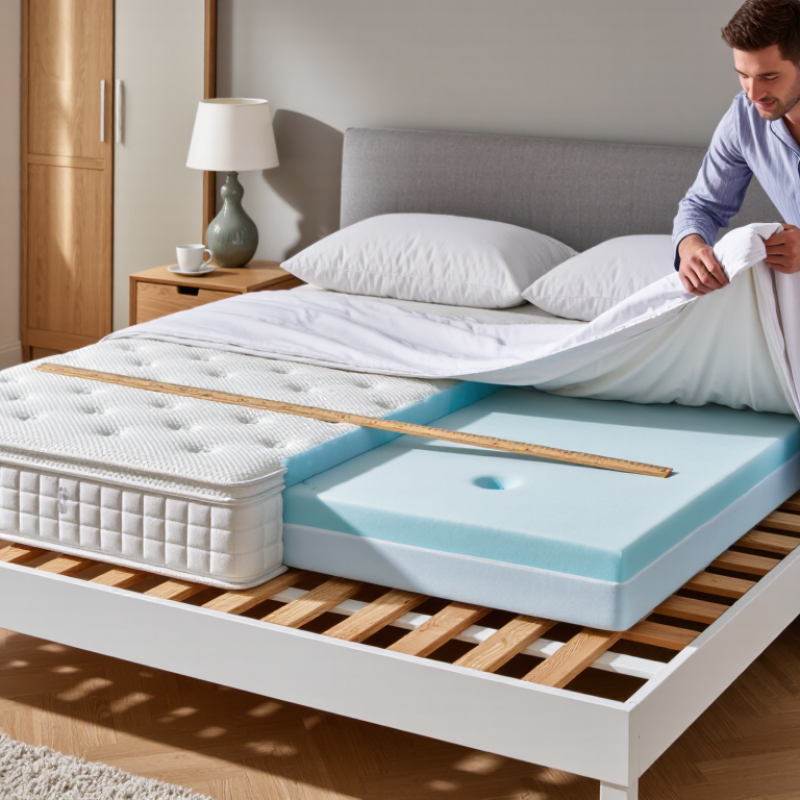
A dip in the middle often develops where sleepers place the most repeated pressure. Memory foam may soften gradually, especially under heavier body areas such as the hips and shoulders. Weak support beneath the mattress can also contribute. Slats spaced too far apart may allow the center to flex. A damaged foundation can create a similar feeling.
Many mattress warranties consider a visible indentation only when it reaches about 1.5 inches without added weight. This measurement is important, but warranty rules differ. Some require a suitable foundation, proper use, and clear proof of the defect. Measure the dip with a straight edge across the mattress. Then measure from the edge down to the lowest point. A ruler alone can mislead if the cover is loose or the floor is uneven. I have seen owners blame the foam before checking the support frame. That assumption is not always correct.
Photograph the mattress from several angles. Record the measurement and purchase date. Check the foundation for broken slats or loose joints. Rotate the mattress only if its care instructions allow it. Avoid placing heavy objects on the surface to test the sag. If the indentation reaches 1.5 inches, review the warranty wording carefully. Some coverage excludes normal softening, even when the mattress feels uncomfortable.
What Is Causing Memory Foam Mattress Sagging in the Middle?
A visible center dip often reflects foam fatigue, not one isolated defect. Repeated loading compresses the comfort layer, especially beneath the pelvis and shoulders. Heat also reduces temporary firmness during sleep. Over time, cells may recover more slowly. A weak foundation can intensify the effect.
ASTM D3574 compression-set testing measures this permanent thickness loss. The common procedure compresses flexible foam to 50% of its original thickness for 22 hours at approximately 70°C. Technicians then measure recovery after release. For example, a 100-millimeter sample retaining only 92 millimeters has an 8% compression set (ASTM D3574, Compression Set). That number is useful, but not a pass-or-fail verdict. Real mattresses experience cooler temperatures, changing loads, and thousands of cycles.
Density and firmness should be read separately. The Polyurethane Foam Association’s technical guidance explains that higher density generally indicates more polymer material, while firmness reflects support response. A firm sample can still fatigue early if its structure is weak. Lab results can mislead. They are controlled snapshots.
During inspection, measure the dip with a straightedge across the mattress. Record unloaded depth, sleeping-position depth, and foundation spacing. A deep center depression with softened foam suggests fatigue. A shallow depression that disappears after several hours may indicate temporary compression instead. Age, room temperature, body weight, and rotation history should be recorded beside the measurements. Small details matter.
A mattress can sag when its foam loses resilience under repeated pressure. The middle often receives the most use, especially when one person sleeps there regularly. A weak foundation can worsen the problem by allowing the foam to bend between support points.
Memory foam density commonly ranges from 3 to 5 lb/ft³. A 3 lb/ft³ layer usually feels softer and responds quickly, but it may compress sooner with daily use. A 5 lb/ft³ layer generally offers greater durability and slower recovery. That difference matters. Density does not describe firmness alone. A dense foam can still feel plush if its formulation is soft. Heat, body weight, humidity, and room temperature may also change how quickly the surface recovers.
In my own inspection, I initially blamed the foam after finding a visible dip. The support slats were spaced too widely. Once the base was corrected, the mattress appeared flatter, though the compressed area did not fully recover. Check the base. Measure slat spacing and inspect the center support before replacing the mattress. Rotate the mattress only if the care instructions allow it; flipping most memory foam designs can create poor support. A ruler and a straight edge can reveal whether the dip exceeds normal settling. Also compare the listed density of each foam layer, not just the total mattress weight. Lower-density comfort foam may be the first weak point, even when the support core remains stable.
What Is Causing Memory Foam Mattress Sagging in the Middle?
Memory foam mattress sagging often begins where body load stays concentrated. Hips and shoulders create repeated pressure during sleep. The effect becomes clearer when a sleeper remains in one position nightly. A weak foundation can intensify the problem. So can excessive heat, moisture, or insufficient foam thickness.
ASTM D3574 25% IFD firmness data offers a controlled way to examine foam response. The test measures the force required to compress a sample by 25% of its original thickness. Higher force usually indicates firmer initial support. However, 25% IFD is not a direct prediction of long-term durability. It does not reproduce years of sleeping, edge stress, or uneven body loading.
Compare 25% IFD values across foam layers, not just the finished mattress. A softer comfort layer may allow deeper hip compression over time. A firmer core can reduce bottoming out, but it may not prevent permanent deformation. Check the foundation for bowed slats or unsupported gaps. Measure the mattress surface with a straightedge after removing bedding. Small differences may come from normal material settling. Large, localized depressions deserve closer inspection.
The result needs context.
My practical concern is simple: one firmness number rarely explains the whole failure. Temperature, density, thickness, sleep posture, and nightly loading should be assessed together. ASTM data improves the investigation, but it cannot replace physical inspection or repeated measurements.
Assessing body-load concentration using ASTM D3574 25% IFD firmness reference points
ASTM D3574 25% IFD measures the force required to compress foam to 25% of its original thickness using a standardized indentation procedure. The reference firmness points shown here are generic, non-brand-specific values converted from 20–50 lbf to newtons. Lower-IFD foam requires less force to compress and may allow greater localized deflection under concentrated loads from the shoulders, hips, and torso. Repeated loading, insufficient support beneath the foam, heat, and material fatigue can gradually contribute to a deeper center sag. IFD alone does not predict long-term durability; compression-set and cyclic-fatigue testing are also required.
Test basis: ASTM D3574, 25% Indentation Force Deflection (IFD). Values are generic reference points for comparison, not certification results.
What Is Causing Memory Foam Mattress Sagging in the Middle?
A memory foam mattress may sag because its support base bends, flexes, or leaves wide gaps between slats. Uneven weight distribution can worsen the dip. So can a weakened center rail.
Check the foundation first.
ASTM F1566 provides standardized mattress testing methods for characteristics such as firmness and durability. It helps professionals compare performance under controlled conditions. However, it does not approve every household bed frame or guarantee proper support in your bedroom. That distinction matters.
Measure the slat spacing with a tape measure. Inspect the center rail for movement. Place a straightedge across the foundation and look for visible bowing. A level floor also helps reveal whether the frame sits unevenly. These simple checks often expose the real problem.
Support should remain flat and stable.
In practical inspections, a mattress can appear defective when the foundation is the weaker component. I have also seen owners rotate the mattress repeatedly without checking the base. That rarely fixes structural movement. Still, testing standards cannot predict every sleeper’s habits, body weight, room temperature, or frame design. My first assumption may be wrong.
Compare the foundation’s construction with the mattress instructions and applicable ASTM F1566 test information. If the center remains low on a firm, compatible base, document the depth and contact the seller or a qualified sleep-product technician. Photos help. Measurements help more.
| Inspection Dimension | Observed or Measured Value | What the Result May Indicate | Recommended Check | ASTM F1566 Relevance |
|---|---|---|---|---|
| Unloaded center height difference | 1.5 in (38 mm) lower at the center than near the side edge | Possible permanent body impression, foam fatigue, or inadequate support beneath the mattress | Remove bedding, allow the mattress to recover, then measure with a straightedge and ruler | Height and durability measurements can document changes in mattress geometry; ASTM F1566 does not establish one universal sagging limit for every mattress |
| Center-support condition | No continuous center beam or center legs touching the floor | The middle of the foundation may flex downward under normal sleeping loads | Inspect the frame from floor level and verify that center supports remain in contact with the floor | Foundation support is a setup condition that can affect mattress test results, but ASTM F1566 is not a substitute for the foundation manufacturer’s structural requirements |
| Slat spacing | 5.0 in (127 mm) clear distance between adjacent slats | Wide gaps can allow localized foam deflection, especially when the mattress has a flexible base | Measure the widest gap and compare it with the mattress and foundation specifications | The standard does not provide one universal slat-spacing rule for all products; support spacing should be confirmed against the applicable product requirements |
| Foundation surface flatness | 0.75 in (19 mm) dip across the center span when unloaded | A bowed or weakened foundation can imitate or accelerate mattress sagging | Place a straightedge across the foundation and measure the largest gap below it | A mattress should be evaluated on a stable, level support surface when comparing observations with standardized test results |
| Sagging location | One broad depression in the center third of the mattress | More consistent with central support loss or repeated load concentration than an isolated edge defect | Rotate the mattress only if permitted; inspect whether the depression follows the mattress or remains over the same foundation area | Durability testing evaluates changes after repeated loading, while field sagging may also result from the support system |
| Foam recovery after unloading | Center depression remains after 24 hours without occupants | Suggests a permanent impression or structural deformation rather than temporary compression | Record the center height immediately after unloading and again after 24 hours under the same conditions | Permanent dimensional change is relevant to durability evaluation, although a home inspection is not an ASTM-certified laboratory test |
| Mattress age and usage | 7 years of nightly use; approximately 2,500 nights | Long-term repeated loading may reduce foam resilience and increase visible impressions | Compare the current surface profile with dated photographs or prior measurements | Durability procedures are intended to assess performance after repeated loading; service life depends on construction, load, environment, and support |
| Uneven occupant loading | Two sleepers repeatedly use the same central sleeping zones | Concentrated loading can accelerate localized compression and make the middle appear lower | Check whether the impression aligns with the usual sleeping positions and body contact areas | Standardized durability tests use controlled loading; household loading patterns are less uniform and may produce different results |
| Temperature and moisture exposure | Bedroom temperature commonly above 80°F (27°C) with elevated humidity | Heat can soften memory foam temporarily; persistent moisture may contribute to material or foundation deterioration | Ventilate the room, use a breathable protector, and inspect for moisture or odor before measuring again | ASTM mattress testing is performed under controlled laboratory conditions, so environmental differences can affect field observations |
Note: ASTM F1566 provides standardized methods for evaluating mattress characteristics such as height, firmness, and durability. It does not create a single universal pass-or-fail sagging depth for every mattress or prescribe one foundation design for all products.
Repeated pressure from hips and shoulders can soften foam gradually. Weak slats or a bent center rail may worsen the dip. The foam may not be the only problem.
Many warranties use about 1.5 inches as a reference point. Measure the empty mattress without added weight. Coverage rules can differ.
Place a straightedge across the mattress surface. Measure from the straightedge to the lowest point. A loose cover can make a ruler reading misleading.
Wide slat gaps can let the center flex downward. Broken slats, loose joints, or a weak center rail can also create movement. The base should stay flat and stable.
Measure the spacing between slats with a tape measure. Check the center rail for movement. Use a straightedge to find visible bowing.
Rotation may redistribute pressure if the care instructions allow it. It will not repair a damaged foundation. Repeated rotation alone rarely solves structural movement.
No. Added weight can distort the measurement and stress the foam. Measure the mattress under normal, unloaded conditions.
Photograph the dip from several angles. Record its depth, purchase date, and foundation condition. Measurements usually show more than photographs.
No. A testing standard supports controlled comparisons of firmness and durability. It cannot confirm every household frame, sleeper habit, or room condition.
Confirm the base matches the mattress instructions. Measure the indentation again and keep clear photos. Contact the seller or a qualified sleep-product technician. My initial assumption could still be wrong.
Why is my memory foam mattress sagging in the middle? Mid-mattress sagging usually develops when the foam gradually loses its ability to recover under repeated body weight. A visible dip may indicate significant material fatigue, especially when it approaches the 1.5-inch depth that commonly appears in warranty guidelines. ASTM D3574 compression-set testing, often performed at 50% compression, helps evaluate how well foam returns to its original thickness after prolonged loading. Foam density is also important: memory foam commonly ranges from 3 to 5 lb/ft³, and lower-density materials may be more vulnerable to early softening and permanent impressions.
Body-load concentration can accelerate wear in areas such as the hips and shoulders. ASTM D3574 25% IFD firmness data can help assess whether the foam is becoming too soft under typical pressure. In addition, an unsuitable or weakened foundation may allow excessive flexing beneath the mattress. Checking the support structure against relevant ASTM F1566 mattress-testing principles can help determine whether inadequate base support is contributing to the sag.

ADC Furniture